Skip to content
GPG Landscape Management

Planned maintenance, done to the same standard on every visit

The planned work that keeps a site tidy, safe and presentable: mowing and edging, weeding, pruning and hedging, garden bed detailing, paved area cleaning, debris and litter removal, and mulching. Each task has a written standard, so you know what a finished visit looks like and can hold us to it.

Many grounds contracts only specify a number of visits. Without a written description of a finished visit, there is nothing to check the work against, and quality drifts.

Eight maintenance services, one standard

Each service is written into the contract with how often it happens and the result it should achieve. Open a service to see what a finished visit looks like and what sits in the fixed monthly fee.

Mowing and edging

Lawns are mown, edges along paths, kerbs and garden beds are cut, and grass is trimmed around poles, signs and fence lines.

How often: every visit through the growing season. Mowing eases over winter as growth slows, and edges are kept defined all year.

Detail and standard

We use push mowers on smaller lawns and confirm the approach for larger lawns at the site consultation. Where the site has a turf program, it sets the mowing height and regime.

Done to standard

  • lawns cut evenly at the height set for the grass type and season, without scalping
  • clean, defined edges along paths, kerbs and garden beds
  • grass trimmed around poles, signs and fence lines without damaging trees or irrigation fittings
  • clippings cleared from paths, kerbs and car parks before we leave.

In the fixed fee: every scheduled visit, at the frequency set in your scope.
Weeding

Every site has a weed control approach written into the scope: hand removal, targeted herbicide applied under our Commercial Operator Licence, and mulch to stop new weeds establishing.

How often: every visit, with herbicide applications at the timing set in your scope.

Detail and standard

Herbicide use is recorded. Where chemical use needs to be kept to a minimum, such as on residential strata or sites used by children, we agree a lower-chemical approach with you.

Done to standard

  • weeds removed or treated before they set seed
  • weeds in garden beds, lawns, paving cracks, joints and kerb lines dealt with by the method set in the scope
  • treated weeds cleared on a later visit once they have died back, where they would otherwise be visible
  • herbicide applied only where it is needed, in suitable weather, and recorded.

In the fixed fee: the weed control approach in your scope, including scheduled herbicide applications.

Routine pruning, trimming and hedging

Hedges are trimmed to their agreed height and form, and shrubs are kept clear of paths, entries, signage, windows and sight lines.

How often: light trimming on every visit; hedges and shrubs typically two to four times per year, timed around growth and flowering.

Detail and standard

Grasses and strap-leaf plants are cut back when they need renewing. Formative and renovation pruning is part of specialist pruning, and trees taller than 5 metres go to a qualified arborist.

Done to standard

  • hedges cut to a consistent height and face, with straight lines where the design calls for them
  • paths, entries, signage and driveway sight lines kept clear
  • clean cuts made with sharp tools, with no torn or crushed stems
  • all clippings collected from beds, lawns and paving.

In the fixed fee: routine trimming on every visit and scheduled hedge and shrub cuts.

Quoted separately: one-off renovation of overgrown hedges and shrubs; arborist work on trees taller than 5 metres.

Garden bed detailing

The finishing work that keeps beds looking cared for between larger tasks: deadheading, removing dead leaves and spent flower stalks, and tidying bed corners and edges by hand.

How often: beds at entries and along main paths on every visit; other beds on a rotation set in your scope.

Detail and standard

Done to standard

  • spent flowers removed, so plants look tidy and keep flowering
  • dead and yellowing leaves removed from strap-leaf plants at the base, without damaging new growth
  • spent flower stalks cut out cleanly
  • beds that look tidy close up, at entries and along paths, not only from a distance.

In the fixed fee: detailing on the schedule set in your scope.

Paved area cleaning

Paths, steps, entries and car park edges are blown on every visit, and each visit finishes with a check of the entries and frontage.

How often: clearing on every visit; pressure cleaning at the frequency set in your scope, if you include it.

Detail and standard

Pressure cleaning can be added to your scope as a scheduled item: we clean entries and paths ourselves, and large car parks and hardstand go to a pressure cleaning contractor.

Done to standard

  • paths, steps and entries clear of clippings, leaves and soil
  • debris collected rather than blown into garden beds, drains or neighbouring properties
  • entries and frontage checked last, so the site is left as a visitor would want to find it.

In the fixed fee: clearing on every visit; scheduled pressure cleaning, if included in your scope.

Quoted separately: pressure cleaning outside the schedule.

Organic debris and litter removal

Leaves, clippings, prunings, small fallen branches and litter are collected, and stormwater grates and surface pits in landscaped areas are cleared.

How often: every visit, with more time allowed during autumn leaf fall.

Detail and standard

Litter is bagged separately from green waste, and small finds of sharps are collected with the right equipment. Dumped rubbish and hard waste, larger quantities of sharps, and unidentified chemicals or anything that may contain asbestos are reported to you rather than removed as routine work.

Done to standard

  • lawns, beds, paving, grates and surface pits clear of leaves, prunings and litter at the end of each visit
  • green waste removed from site, not left in piles or bins on the property unless agreed
  • litter kept separate from green waste
  • anything outside planned maintenance photographed and reported, with a recommended action.

In the fixed fee: leaf, clipping and pruning removal, including green waste disposal; litter removal from landscaped areas; clearing stormwater grates and surface pits.

Quoted separately: storm and emergency clean-ups; removal of dumped rubbish and hard waste; clearing blocked stormwater lines.

Mulching

Mulch holds moisture in the soil, suppresses weeds and gives beds a finished look.

How often: typically topped up once per year, at the time set by the soil health program or your scope.

Detail and standard

Where the site has a soil health program, it sets the mulch type, depth and timing; otherwise the mulching schedule is set out in your scope.

Done to standard

  • beds weeded before mulch goes down
  • mulch spread evenly to the depth set in the scope
  • mulch kept clear of plant stems, building walls and paving edges, with none left on paths.

In the fixed fee: mulching on the schedule set in your scope.

Replacement planting

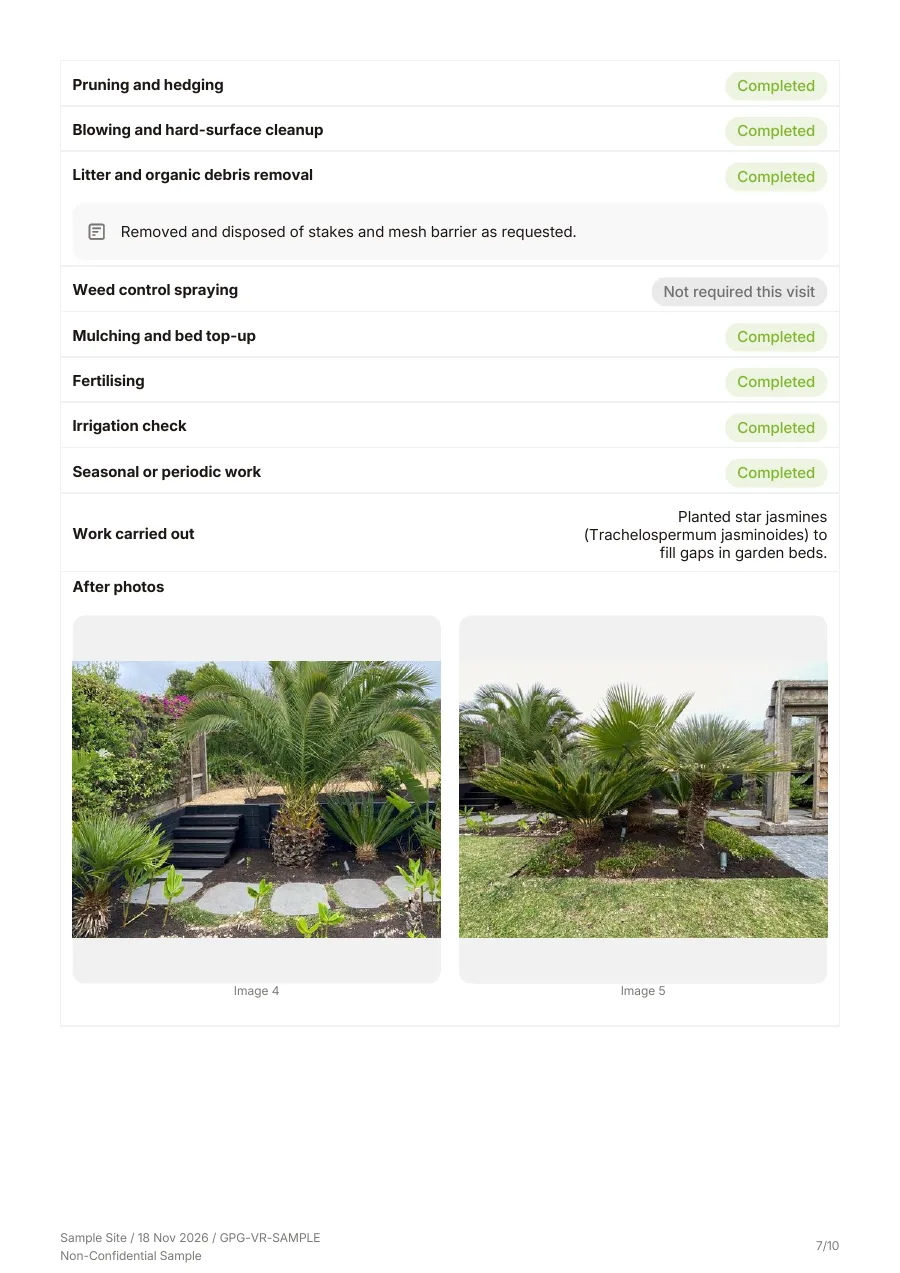
When a plant fails or is damaged, we record it in the visit report with a recommended replacement.

How often: as needed. Failed plants are reported as they are found.

Detail and standard

The replacement is usually like for like, or a better-suited plant, often an indigenous or drought-tolerant one, where the original struggled. Replanting a whole bed or area is part of a rejuvenation program.

Done to standard

  • plants suited to the position, the site's conditions and the existing planting
  • planted at the correct depth, backfilled and watered in
  • mulch restored around the new plant
  • each replacement recorded in the visit report.

Quoted separately: replacement plants and planting; larger replanting as part of a rejuvenation program.

Visits are scheduled around the people using the site: agreed equipment hours and resident access on strata sites, and loading times and inductions on industrial sites.

How the work changes through the year

Most services happen on every visit, but the time each one takes rises and falls with the seasons. This is how a typical year runs on a site in Melbourne's south-east.

A typical year of maintenance in south-east Melbourne, by month: busy, ongoing or not usually done
JJanFFebMMarAAprMMayJJunJJulAAugSSepOOctNNovDDec
Planned maintenance
Mowing and edgingJanuary: BusyFebruary: BusyMarch: BusyApril: BusyMay: OngoingJune: OngoingJuly: OngoingAugust: OngoingSeptember: OngoingOctober: BusyNovember: BusyDecember: Busy
WeedingJanuary: OngoingFebruary: OngoingMarch: OngoingApril: BusyMay: BusyJune: OngoingJuly: OngoingAugust: OngoingSeptember: BusyOctober: BusyNovember: BusyDecember: Ongoing
Hedge and shrub cutsJanuary: OngoingFebruary: BusyMarch: BusyApril: OngoingMay: OngoingJune: not usuallyJuly: not usuallyAugust: not usuallySeptember: BusyOctober: BusyNovember: BusyDecember: Ongoing
Leaf fall and grate clearingJanuary: OngoingFebruary: OngoingMarch: OngoingApril: BusyMay: BusyJune: BusyJuly: OngoingAugust: OngoingSeptember: OngoingOctober: OngoingNovember: OngoingDecember: Ongoing
Replacement plantingJanuary: not usuallyFebruary: not usuallyMarch: not usuallyApril: BusyMay: BusyJune: BusyJuly: not usuallyAugust: not usuallySeptember: not usuallyOctober: not usuallyNovember: not usuallyDecember: not usually
MulchingJanuary: not usuallyFebruary: not usuallyMarch: not usuallyApril: not usuallyMay: not usuallyJune: BusyJuly: BusyAugust: BusySeptember: not usuallyOctober: not usuallyNovember: not usuallyDecember: not usually
Pressure cleaningJanuary: not usuallyFebruary: not usuallyMarch: not usuallyApril: not usuallyMay: not usuallyJune: not usuallyJuly: BusyAugust: BusySeptember: not usuallyOctober: not usuallyNovember: not usuallyDecember: not usually
Common specialised programs
Garden bed fertilisingJanuary: not usuallyFebruary: not usuallyMarch: BusyApril: not usuallyMay: not usuallyJune: not usuallyJuly: not usuallyAugust: not usuallySeptember: BusyOctober: not usuallyNovember: not usuallyDecember: Busy
Irrigation managementJanuary: OngoingFebruary: OngoingMarch: OngoingApril: OngoingMay: OngoingJune: not usuallyJuly: not usuallyAugust: not usuallySeptember: BusyOctober: OngoingNovember: OngoingDecember: Busy
Regenerative pruningJanuary: not usuallyFebruary: not usuallyMarch: not usuallyApril: not usuallyMay: not usuallyJune: not usuallyJuly: not usuallyAugust: BusySeptember: BusyOctober: OngoingNovember: not usuallyDecember: not usually

A typical year in south-east Melbourne. Your scope sets the specific timing for your site. Mulching and replacement planting are also done whenever they are needed, such as when we take over a new site.

Planned maintenance carries out the plan on every visit

Strategic advisory sets the priorities for the site. Where a site has specialised programs, they set how turf, soil, weeds and other systems are managed each season. Planned maintenance carries that work out on every visit, to a written standard. Information also flows back: weeds, pest damage, dry patches or pooling water noticed on a visit are recorded and passed to the relevant program.

Reporting

A record of every visit

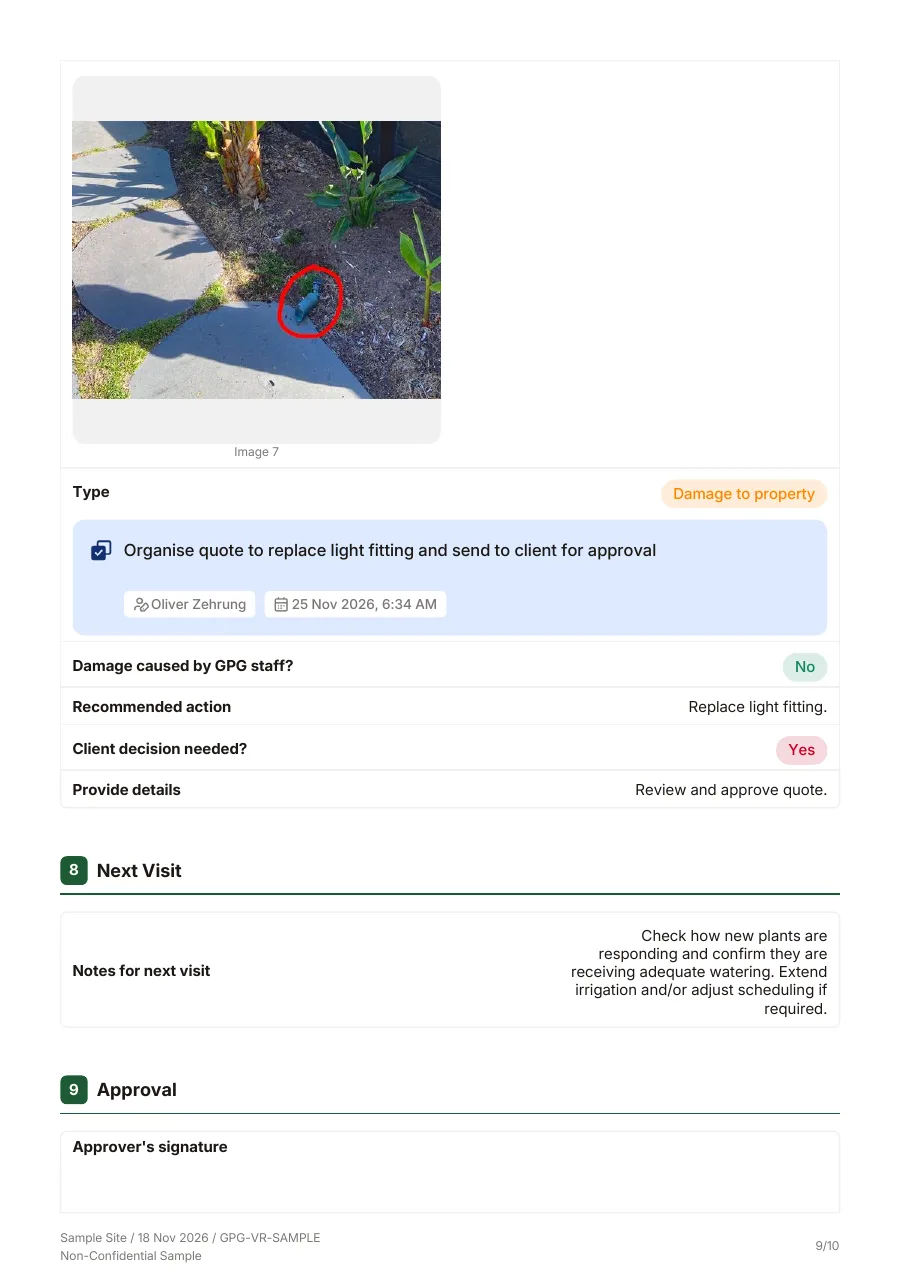
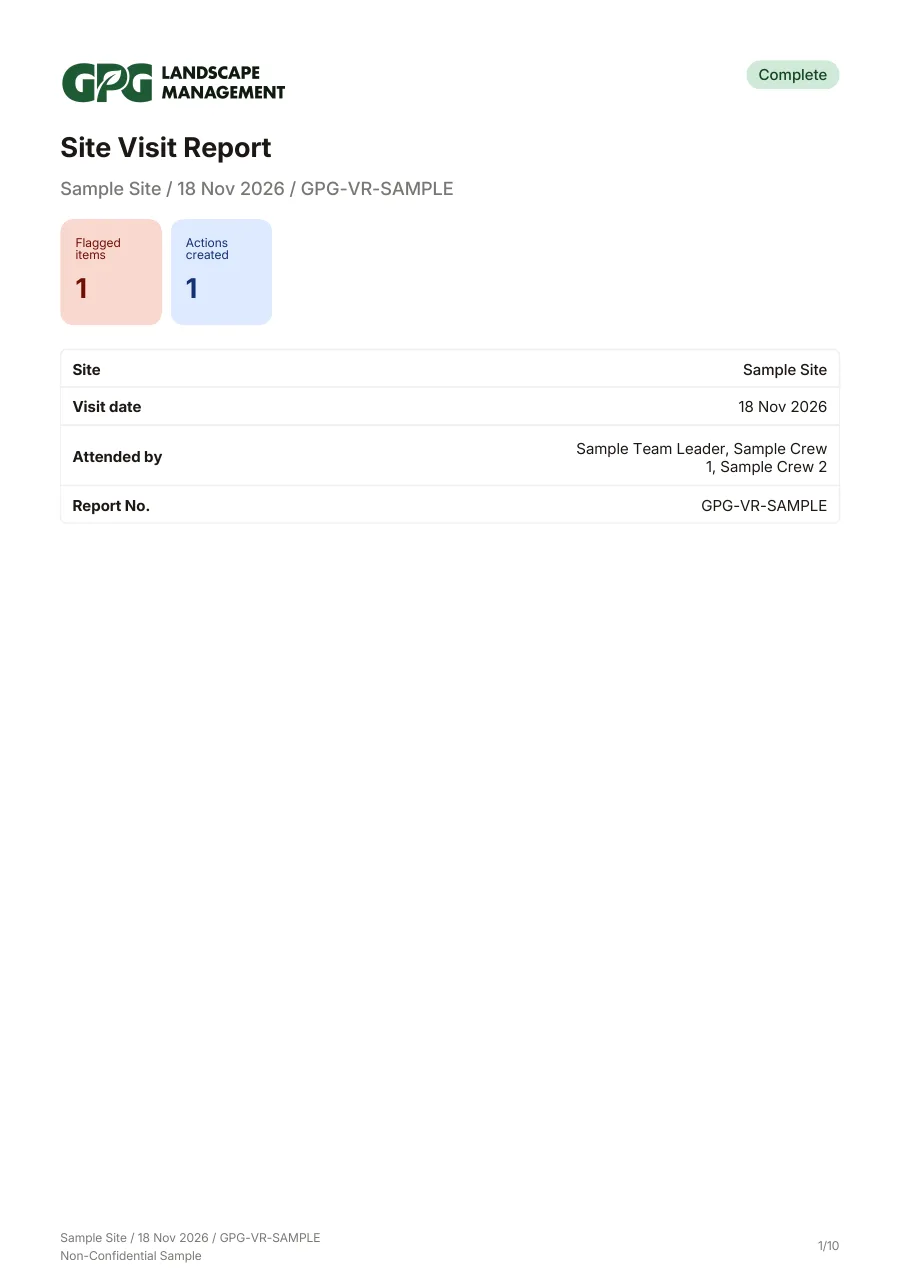
After each visit, you receive a report of the work completed against the scope. Hazards we observe, such as lifted paving, a loose garden edge or a branch hanging over a path, are recorded with a photo, a recommended action and whether a decision is needed from you. Urgent items are reported by phone the same day.

The reports build into a dated record of how the grounds have been maintained over the life of the contract.

Sample visit report cover: site, visit date, crew, and counts of flagged items and actionsSample visit report page 7: work completed checklist with notes and after photosSample visit report page 9: a broken garden light circled in a photo, with the recommended action and client decisionDownload the sample visit report (PDF) →

Additional works

Unexpected work quoted and approved first

Planned maintenance is predictable, so almost all of it is in the fixed monthly fee. Work that depends on events, such as a storm or a failed planting, is quoted, approved by you and drawn from your additional works budget.

Work added to a scheduled visit is charged by the hour. A separate visit for additional works has a minimum charge of two hours per person.

See how we price our work →

See what a defined standard would look like on your site

In a free site consultation, we look at the site with you, agree what each visit should achieve and explain what it would cost. If your site needs its lawn cut and nothing more, a local gardener or mowing contractor will usually be cheaper, and we'll tell you so. It takes about an hour, and there's no obligation.